R02, Yuriya Miyako ‘16, Chiyo Miyako, Great-Grandmother, 1901, Manchuria, Wakayama
I interviewed Chiyo Miyako at her elder-care home on November 9, 2014. She is 113 years old. She is my paternal great-grandmother, but I will refer to her as “Grandma,” since that is what I call her. [Before her death at the age of 117 in 2018, Chiyo Miyako was recognized by the Guinness Book of Records as the oldest person in the world.]
Me: Hi, Grandma! I haven’t seen you in so long! How are you?
Grandma: I’m doing well. Thank you for asking. You’ve grown so tall in such a short period of time! Anyhow, I heard from Naoto [my father] that you wanted me to talk about my memories and experiences of World War II. Well, I could tell you, but I’m only comfortable discussing certain parts of the war, so it’s not my entire experience. Is that fine? I’ve told your mother some of the events during the war, but you’re the first person to ask me about it.
Me: It would be great if you could tell me as much as you can about World War II. What was life like back then?
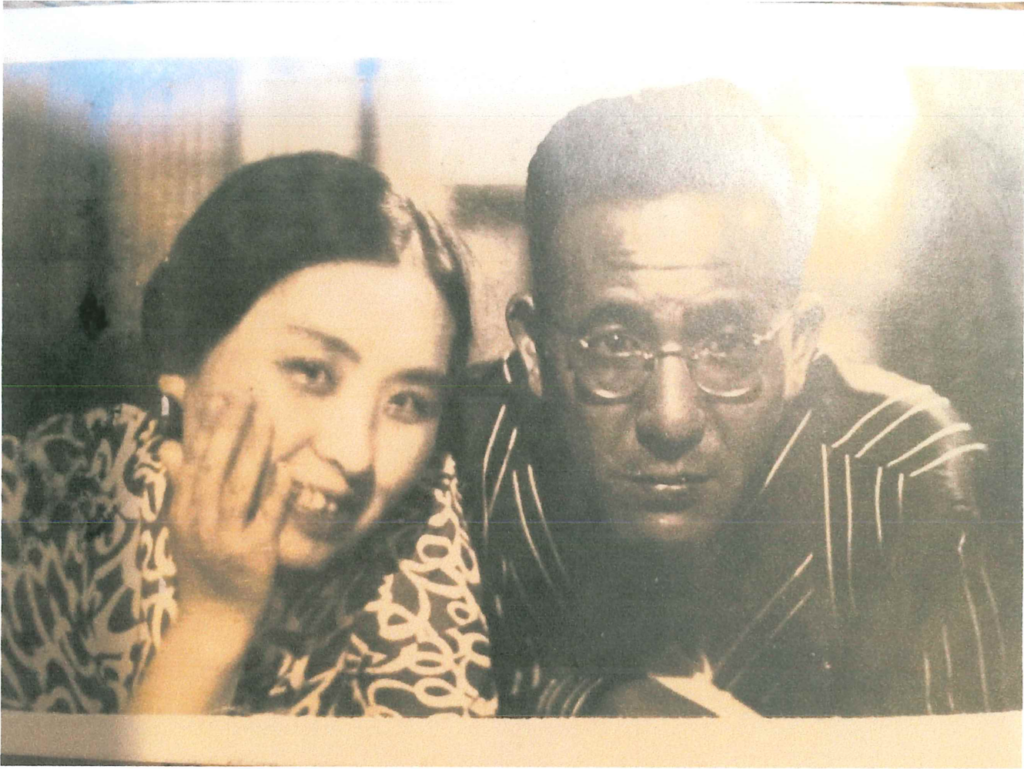
Grandma: I’m not sure where to start, but I’ll just start talking. Katsuji-san [her husband] was a college student before the war, so I was supporting the household. I worked as a person who connected two people so that they could talk on the phone, in Ōsaka. After Katsuji-san graduated from Tōkyō University, he worked for the Tetsudō Sōken,which eventually became the Japan Railway (JR) companies. Because he worked there, he was transferred to various locations in Japan, for example, Tōkyō, Nagano, Kōbe, and prefectures in the Kyūshū area. Every time we moved to a different location, I’d order a new, beautifully made kimono. Anyway, we probably lived in every single region where there are train tracks today.
Me: So you followed wherever he went?
Grandma: Well, of course. I mean, he couldn’t live on his own, and I needed to take care of our children. In 1932, Manchuria was established, so we travelled to live there. However, because my eldest son, Jun’ichi, was 10 and was still in elementary school, Katsuji-san and I decided to leave him in Japan with my family. So Katsuji-san, our daughter, who is your father’s mother, and I travelled to China, but we frequently came back to Japan. I think our first destination was Beijing, and then we made our way north through China. You know how our family has a strong interest in food, right, Yuriya? That’s why when I was in Manchuria, I hired a maid, who would teach me how to make dumplings, and they were absolutely delicious. I obviously don’t remember how to make them anymore, but Katsuji-san enjoyed them a lot.
Me: So you hired a maid just to teach you how to cook? It seems like you did a lot for Katsuji-san.
Grandma: No, of course not. She helped out with washing clothes and preparing dinner too. Back then it was normal. Katsuji-san worked very hard, and he deserved it. Anyway, what were we talking about? Oh yes, I think it was around 1935 or 1936, when Katsuji-san was dispatched to visit Western countries in Europe and North America for a year for railway research purposes, apparently because initially the Olympics were supposed to be held in Japan in 1940, although they were cancelled. The government wanted him to investigate the forms of transportation in other countries so that we could apply them in our country efficiently. I think he eventually ended up writing a report on the Berlin Olympics, but because it was during the Nazis regime, after the war, Katsuji-san was almost put on trial as a war criminal for some pathetic reason. But because he travelled to Europe for research purposes of Tetsudō Sōken, he wasn’t put on trial.
Me: He was in Germany under the Nazi regime? That’s unbelievable!
Grandma: Yes, he was. I remember I was just so relieved to see him after he came back safely. I didn’t go to Europe and America with Katsuji-san so when I was in Japan for a short while, I visited the chef who worked for the United States Consulate-General in Kōbe to learn Western cuisine recipes, just in case Katsuji-san wanted to eat Western meals after he came back. I told you that we kept going and coming back to Manchuria and Japan right? After Katsuji-san returned, and when we were living in Manchuria, there was a terrifying incident called the Marco Polo Bridge incident. I remember it broke out in 1937, so we immediately returned to Japan. However, Yuriya, there is one thing you probably don’t know yet.
Me: What is it?
Grandma: We had three children; two boys and one girl. Our youngest child, who was approximately 1 years old, died on our way back to Japan due to dysentery. The panic caused by the Marco Polo Bridge incident was immense, so we could not even process the ashes properly.
Me: What’s dysentery?
Grandma: It’s basically an infection in the stomach or intestine that causes diarrhea. For six years from 1939, when the war broke out, we met up with our eldest son who was a high school student, like you. We all lived in Chōfu in Tōkyō. I remember the neighbors met up and started sewing monpe (loose work pants) to wear instead of kimono. We also started planting seeds because we didn’t want to struggle from the lack of food. I think we even ate plant roots, snakes, and frogs. However, when we suffered even more, I went to the Hachiōji area to barter my kimono for food and necessities. We were really desperate to have food in the house. People traded objects for necessities then. Later, when the war intensified, I had to give my jewelry and metallic objects to the government; they wanted anything that would be considered valuable. The USA started bombing cities in Japan, so our family created an air-raid shelter for safety.
But soon after, Katsuji-san had to go to war; the Army conscripted him with a red paper called akagami. Our eldest son didn’t have to go to war, because he was already a student at Tōkyō University. As soon as Katsuji-san left us, we repainted the white walls of our house black, using soot, and we covered up lamps or lights to prevent our house or area from being targeted.
There was also a belief called Sennin-bari, that if you ask one thousand people each to sew one stitch in a strip of cloth, the men will return safely from war. I asked women in the neighborhood to sew my clothes for Katsuji-san. Of course, I sewed theirs too. Oh, yeah, I also remember! We had something like a women’s association in our area, and the women made weapons out of bamboo to practice self-defense. In Tōkyō, there were black markets too, where I sometimes bought necessities I couldn’t receive from other houses.
Me: I’ve only read about black markets through fictional graphic novels and media, but did they actually exist in Tōkyō?
Grandma: Yes, they were sketchy, but people in the neighborhood were that desperate. Anyway, soon afterwards my daughter was forced to “voluntarily” work at the Red Cross, but because she was in a condition of malnutrition, when she witnessed a patient go through surgery, she fainted, since she saw a lot of blood.
The government used to distribute food like rice, but as the war worsened, the amount per family decreased. I felt like our family was in a really serious and dangerous situation, so we moved to Wakayama, where my family and relatives lived. My family was pretty wealthy, and in Wakayama there were mikan and seafood, so we didn’t struggle finding food as much as we did in Tōkyō. We were fortunate, because the Great Tōkyō Air-Raid occurred right after we left for Wakayama.
I remember clearly the moment Japan lost the war, because the Emperor announced it on the Gyokuon-hōsō [radio address]. He used a ton of euphemisms to announce that we had lost the war, which irritated me a lot, because I wished he had just simply stated that we lost. Later on, Katsuji-san returned from the war safely in 1945 and it was truly surreal to see him again, as I feared that I might never see him again. The time I saw him after the war was probably one of the happiest moments I experienced since the beginning of World War II.
Me: So if you hadn’t moved back to Wakayama, the Great Tōkyō Air-Raid could have affected you and your family?
Grandma: I suppose so. When I reflect back on it, it was a great choice.
Me: Thank you so much for sharing your memories and experiences with me, Grandma.
Grandma: I’m glad I was able to help, Yuriya.