N05F, Chris Miyabe ‘07, Sadatsugu Miyabe, Grandfather, 1917, Philippines, Taiwan, Indonesia
I interviewed my paternal grandfather about his involvement in World War II. His name is Sadatsugu Miyabe, and he was born on November 2, 1917, so he had just turned 88 years old when I interviewed him. This was on November 6, 2005, at a Lotteria fast-food restaurant in the suburb of Kita-Senju. He insisted on this location, because my sister and I often ate there with him when we lived at his house. Below are my questions and my summaries of his answers.
Q: First, can you tell me how you were drafted into the Army?
A: At that time, there was a draft system (chōhei-kensa), which meant that, at the age of 20, male citizens of Japan were tested to see if they were viable to join the army. Since I passed, I was enlisted in the Army for three years.
Q: What kind of tests were there?
A: They measured your height and weight. If males were at least 160 cm tall and 50 kg in weight, they would pass the test. They would fail if they were handicapped in any way. I was 165 cm and 60 kg then. After that, I was stationed in Taiwan to guard a barrack on training grounds there and promoted one rank and star above.
Q: How were the ranks composed then?
A: The ranks were composed in this order:
Private (E-1) nitōhei: one star: The lowest of the low. Everyone started here except those who had graduated from college. Since college graduates had more knowledge, they were given the privilege of starting as a Private First Class after three months of training.
Private (E-2) ittōhei: two stars: One rank above. E-1 Privates were promoted after gaining experience. The average time to achieve this rank was one year.
Private First Class jōtōhei: three stars. From this rank onward, soldiers could be promoted from here if they demonstrated skills and ability.
Corporal gochō: Stripe
Sergeant gunsō: one star with a stripe
Sergeant Major sōchō: two stars with a stripe
I rose to the rank of Private First Class after one year and achieved the rank of Corporal by the end of the war.
Q: What role did you play in World War II?
A: After serving three years (from 1938 through 1940) in Taiwan, in the artillery squad (koshahō-butai) and achieving the status of corporal, I was discharged from the Army. However, I was re-summoned back into the Army in 1941 and traveled around Asia on a naval ship commanding the artillery.
My job was to take orders from my superiors and make sure they reached the lowest ranks and were carried out. My other job, as a corporal in the artillery squad, was to look at the radar and tell my subordinate artilleryman what type of plane was coming, from where, and at what speed. I don’t remember downing many planes. I went to the Philippines (Manila, Mindanao, and Lingale Island) to support the Japanese forces and to Indonesia (Java and Lavael) and also to Guadalcanal island to aid the Japanese force in conquering the areas.
In the Philippines, the naval force (composed of three main battleship groups) was supposed to support the Japanese forces in conquering Lingaele Island, where the main American army, navy, and air force seemed to have been stationed. The Japanese forces succeeded in conquering the area by destroying the planes at the airport and taking control of the airfield, but it seems that after doing so, American forces swarmed the area quickly and destroyed the Japanese army. The Navy division that I was in was supposed to assist the Japanese in defense, but we were too late on their arrival, and we were forced to retreat.
I witnessed how the American forces fought. The Americans were mainly in a defensive position, always barricaded until they were forced to move. I believe that they did so because they knew that defense meant fewer casualties. For defense on land, they had tanks in the first wave and troops following. They were stationed until Japanese forces reached their range. Other than that, planes distracted and attacked the Japanese naval forces from supporting troops on land with their cannons. American submarines were numerous, and Japanese destroyers kept on throwing tons and tons of depth charges to defend themselves. In the end, the Americans were too numerous, so we were forced to retreat. The ship I originally was on was abandoned, and troops retreated with an even more agile and smaller ship.
In one of the battles in Indonesia, one of the squadrons in my division sank the British ship Prince of Wales off the coast of Macao. [I remembered making a plastic model of that ship when I was in middle school, and I was amazed.] The airplanes held the key often in battle at sea. My unit clashed with Australian forces too. They had cowardly troops who surrendered after only a few days. After that, I went back to the Philippines and got discharged from service because of malaria and dengue fever, in December 1944.
Q: How did you feel when Japan lost the war?
A: Honestly, I thought Japan would not win the war in the first place. I thought so because, when I was still a high school student, I worked in a company that dealt with chemicals. I found out that Japan was lagging behind in technology and even population, so I could not see how Japan could win against America. I thought, all throughout my time in the service, that in the end Japan would not win. I thought a lot of people in the Army might have known this or perhaps they convinced themselves that they were strong. Fighting spirit can cover up some factors in war, but by simple calculation, guts alone is not enough to repel a strong foe. I was not surprised that Japan lost.
Q: Did losing the war affect you in any way or change your life?
A: Strangely, there seemed to be no change. After the war, I founded a company. I earned a fair amount, but then I failed and quit. After that, I set up three mahjong franchises and a café, but they failed due to undesirable employees and my lack of checking up on them.
Q: Is there anything you would like to say about World War II in general?
A: Spirit and guts had their limits, and Japan should look to take in the good traits from foreign countries and discard obsolete ideas. The main reason Japan was able to remain independent and not in ruins was because Japanese people had an imperial family. As long as there was an imperial line, foreign influence would not get any loyalty or control in Japan.
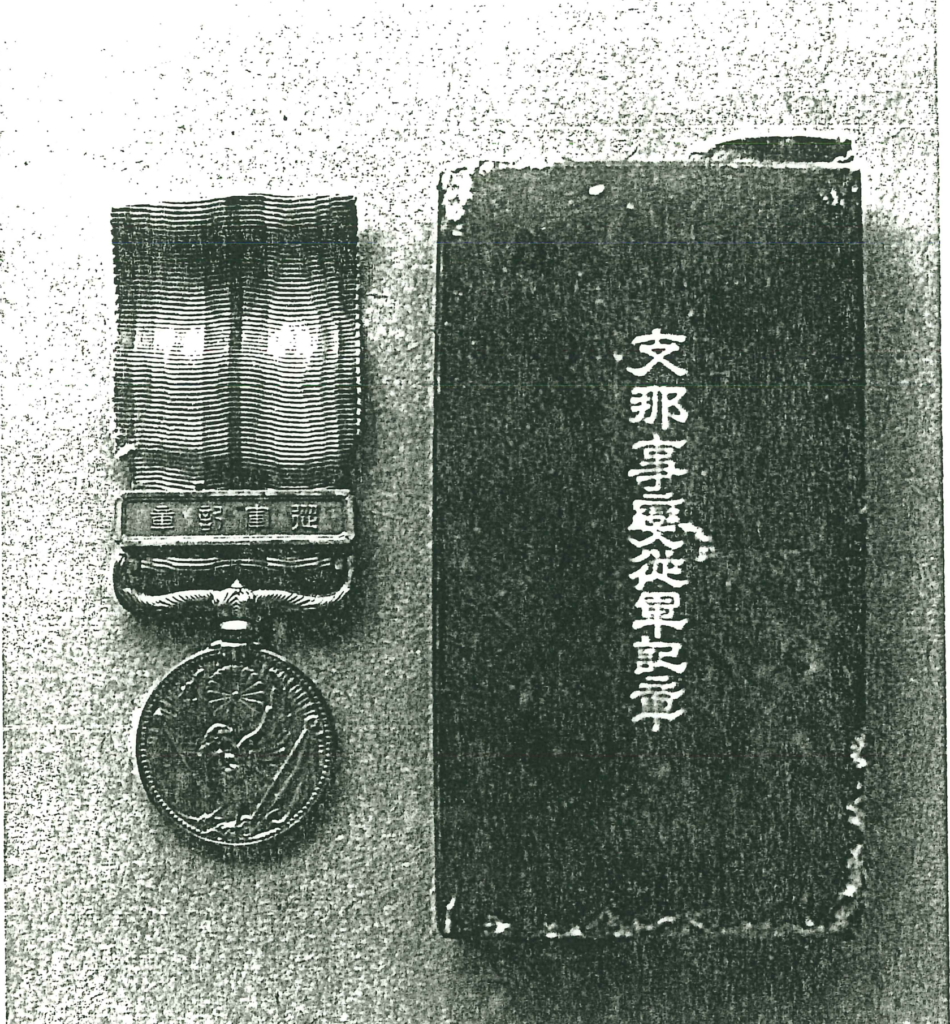
That concluded the interview. However, we decided to go to his home where he said he had more materials and references. Upon arrival, he showed me his badges and pictures. Most valuable of all, he handed me a copy of his military service log. Apparently he compiled it in order to be paid a higher pension. For his military services, my grandfather is paid a pension of 550,000 yen every year. Since he believed that he was a Master Sergeant at the time he was discharged, he thought that he should have gotten a higher pension. As it turns out, now all soldiers regardless of rank are paid the same amount every year.
Q: Why do you say that you thought you were a Master Sergeant?
A: During the last months of my service, I was told that I would be promoted to Master Sergeant, but I got into a fight with a superior, to the point that a saber was drawn. The superior calmed down, and at that point I was suffering from malaria and dengue, so I was sent to a hospital in Kumamoto.
Q: What did you do to cause this fight?
A: When I was sick, I was too lazy to go to the bathroom, so I urinated out the window. That was the root of the fight.