H02I, Sugandhi Chugani ‘00, Tatsuko Matsumoto, Neighbor, 1930, Shizuoka
On November 1, 1998, I interviewed Mrs Tatsuko Matsumoto. She is 68 years old and is one of the survivors of World War II. Mrs Matsumoto is the next-door neighbor of our family friends. The interview took place at our friends’ residence located in Isogo-ku, Yokohama, for approximately two hours. Presently Mrs Matsumoto lives with her husband and two daughters.
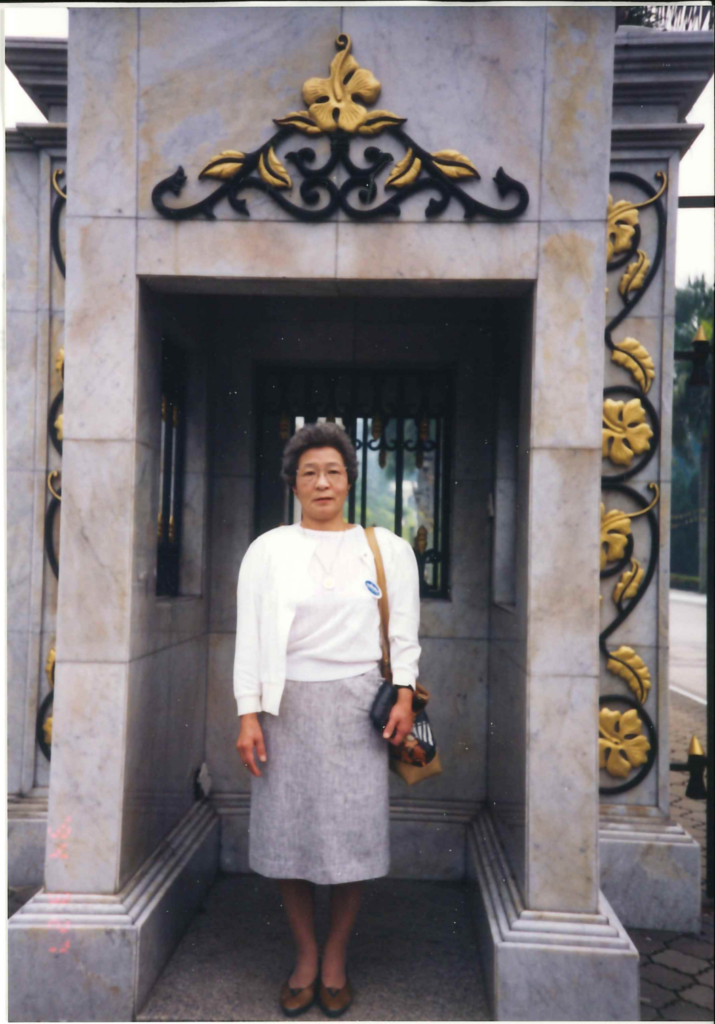
Although it was our first time to meet, Mrs Matsumoto revealed her wartime experiences and feelings to me quite openly. Mrs Matsumoto was born in 1930, and during the war she was in her pre-teens. She had seven siblings, of whom two older sisters had gotten married and lived elsewhere. Her father was a blacksmith but was unfortunately put out of business during the war due to the lack of availability of iron. One of Mrs Matsumoto’s brothers was recruited into the Imperial Army during the war. Mrs Matsumoto lived with her parents and four siblings near Iwata in central Shizuoka prefecture. She lived in a relatively small house located along the Tenryū-gawa River with her family and some neighbors. Mrs Matsumoto recalled that they always covered the old-fashioned lamps that hung from the ceiling with black cloth so that the nightly B-29 bomber planes would pass over them and not drop a bomb. There was an emergency backpack in the house containing food (if they had any), some clothes, and a blanket or bōkūzukin, tough cotton stitched in the shape of a big hat and worn over the head to protect it in times of earthquakes, fires or air raids.
Mrs Matsumoto said that she hated it when the air raids took place just after 12:00 noon, when the students were about to eat their lunches. They would be absorbed in the food, but the bombers would begin their attacks. The students would have to leave their long-awaited meal and run for shelter. Mrs Matsumoto also recalled how everyone used to drink hot water out of the lids of their lunch boxes, because there weren’t any cups.
Mrs Matsumoto attended an all-girls middle school. During the first year, she remembers studying a little, but most of the time she and the other students were sent off to help on the local farms. This was called kinrō-hōshi (labor contribution), since all of the men were either busy in military training or building weapons. She and the other female students would help the planting and harvesting of crops. In return they received a small, dry, hard piece of sweet potato for lunch, because there was no food at home Mrs Matsumoto also recalled planting rice seeds at one point. During physical education, one of the high-ranking officials from the Japanese Army trained the girls to march, but they were often too hungry to participate effectively. She said that the official was always very strict and unyielding.
Every morning school began at 8:30, and before school Mrs Matsumoto recalled writing the details of the previous day’s bombing and learning that Japan was winning the war so far. The newspapers and radio were all censored, and they promulgated only good news about Japan. Every time there was a bombing raid, although in reality there was major damage and many casualties, the newspaper and radio made it sound as if it was not a big deal and that Japan was still winning by far. Japanese people were forbidden to listen to non-Japanese radio. The use of English was outlawed as well. Previously the musical scale had been “do-re-mi-fa-so-la-ti-do,” but since that represented Western influence, it was changed to “i-ro-ha-ni-ho-he-to-i.”
In addition, every morning the students and teachers all bowed to the picture of Emperor Hirohito, adorned in a miniature temple mounted on a long pole. The emperor’s picture was to be regarded with respect. Every time anyone went past the picture, they had to bow. This shows how patriotic everyone was supposed to be, willing to surrender all for the good of the country.
The most vivid memory Mrs Matsumoto has about the war was when she was returning home from a farm one day. During the evening, she was walking through the forests and hills, when an air raid began. She recalled ducking into the bushes between tea plants as quickly as she could, but as soon as she looked up, her eyes met the eyes of an United States pilot flying a P-51 fighter plane so low that she clearly saw the goggles that he was wearing. Luckily he didn’t shoot at her, realizing that she was just a child. Mrs Matsumoto stated that the image of the goggles remains with her even today.
Mrs Matsumoto doesn’t recall wearing her school uniform more than a few times. She said that ordinary people wore monpe during the war, which consisted of baggy pants connected to a top similar to a kimono, usually made of thin cotton cloth. You had to stitch on your details such as name, address, and blood type. This served to identify dead bodies, as well as to help people back to their families in case they got lost during the numerous air raids.
She also recalled that her father made her wooden sandals, geta, since they had no shoes. She remembers how hard it was to walk through the forests and hills for 20 minutes to get to her school wearing geta, but they were better than nothing. One time, a box full of shoes was sent to the school by the government to be distributed amongst the students. There were 50 students per class, and each class got two pairs of shoes to distribute by lottery. Mrs Matsumoto recalled that the happiest time was when her name was drawn, and she received one pair. She used the shoes very sparingly, and one day it rained, so she took them off and ran barefoot gripping them tightly in her hand.
There were no private baths at that time, especially since there was a shortage of firewood needed to heat water. Mrs Matsumoto reminisced that she and her family went to a public bath to bathe once or twice a week, and they couldn’t wash their monpe and other clothes, because there wasn’t any detergent. There were no sanitary pads either, so the girls and women took cotton wool or used quilts and placed some ordinary cotton. Then they secured the temporary pad in place by using a fundoshi, a long stretch of cloth used by men as underwear, by wrapping it around their torso. She recalled how uncomfortable it was and also how she used to worry whether the blood would leak, especially since her mompe was very thin and, to make matters worse, light-colored.
Mrs Matsumoto said that the lack of food was probably the most difficult thing to overcome. Since she, along with many other girls, was going through puberty, she needed the right amount of nutrition to grow and keep up with the changes occurring in her body. Every day to and from school she would look forward to picking wild peaches and berries to savor. Often she would have to wait for them to ripen. There was absolutely no rice at all available to the common people. Rice was a luxury, and Mrs Matsumoto recalled how she and her father used to visit the wealthy rice farmers to trade clothes and, if possible, their last remnants of furniture, for food. This form of barter was called butsu-butsu-kōkan. Since many common people like her family would plead with the rice farmers to trade for food, the farmers could pick and choose whom to trade with.
Mrs Matsumoto recalled receiving dried sweet potatoes from the occasional food supplies. The potatoes were very hard and tasteless, but by beating them into powder, it would be easy to carry around. In addition, she said that she used to find wild grass growing in the forests, as well as various sprouts and shoots of different unidentifiable types of vegetation. She remembered that the leaves of sweet potatoes were especially dry and sour, but not as bad as the stems and stalks, which were hard as well as dry and sour.
Mrs Matsumoto continued to tell me about the situation of the boys and girls under the age of 25. During the last year of the war, boys who were attending university were instead forced to become kamikaze pilots. Boys who were attending vocational schools, as well as those who made it into the higher schools (which were considered elite at that time) had to enlist in the Army or Navy. Mrs Matsumoto’s brother was part of the elite attending higher school, and therefore joined the Army and learned how to fly planes. Older elementary students who were not able to enter middle school were sent to factories to make weapons and various supplies needed for war. Even elementary school students had to work in the factories.
In the case of girls, the situation was very different. Middle school students either went to factories to make weapons along with the older elementary boys, or they could serve in the Red Cross hospitals for soldiers injured during the war. Mrs Matsumoto’s eldest sister was able to avoid making weapons (and thus avoid contributing to the continuation of the war). Instead she joined the Red Cross and studied to become a nurse. Middle school students, such as Mrs Matsumoto herself, took part in kinrō-hōshi, helping on farms. Elementary school girls were forced to evacuate from the cities. They had to leave their homes and live in rural areas in big groups. They were supervised by some of their teachers. This was called sokai (evacuation). Mrs Matsumoto said that she heard that the rural areas were especially unsanitary, and that some girls ended up eating toothpaste due to the lack of food.
Mrs Matsumoto recalled how the American bomber planes entered Japanese airspace by flying over the Izu Peninsula. They then headed towards Mount Fuji, which was their landmark. Often they would fly towards Nagoya and other big cities to bomb them. On the way back, they would pass over the Tenryū-gawa River, which was very close to where Mrs Matsumoto lived, and dropped their leftover bombs, just before flying back over Cape Omaezaki on the Pacific coast.
These air raids were very unpredictable, and Mrs Matsumoto recalls her fear and uncertainty during those times. The U.S. Navy had several ships near the coast of Omaezaki so they could launch planes whenever it was convenient for them. Bombing directly from the ships was called kanpō shageki. The city of Hamamatsu was bombed several times, and her eldest sister was involved twice but survived both times. Mrs Matsumoto recalled how the sea would burst due to the impact of the bombs. Since her school was at a convenient location because it was close to Omaezaki many soldiers of the Japanese Army would stay for a period of weeks. She and her schoolmates would have to do all the cleaning and washing for those men, and in addition they built air raid shelters for the men.
After the war ended, the attitude towards the Emperor changed dramatically. After the arrival of General Douglas MacArthur, the whole education system changed. New textbooks bound with pieces of string were distributed. Mrs Matsumoto recalled being told by her teachers to blacken the sections of her textbook praising Japan and the Emperor with black ink. The teachers suddenly began promoting Western ideas. The same teacher who had criticized English began to teach English to the students. She said that she could not believe the mercurial attitude of the whole country. She refused to learn her ABCs and was totally reticent in class.
The United States did not leave Japan totally in a state of abject poverty. Some U.S. Army and Navy officials who stayed in the facilities of the Japanese Army provided Japanese people with food. Mrs Matsumoto recalled that she and the other female students were told to go home quickly the day that soldiers of the U.S. Army arrived, just in case they would get assaulted. She also remembered how each family got one can of soup each. Laughing, she told me how they didn’t know how to open the can. When they finally yanked it open, they were disappointed to find only clear liquid, but upon tasting it she recalled how good it was. In addition, they also received flour. Mrs Matsumoto recalled how she and her family made suiton (dough balls in an onion soup stock) for the first time, using flour provided by the United States. She said that she would never forget how delicious the suiton tasted. A group of Catholic nuns in the United States sent over clothes and shoes as well. Mrs Matsumoto remembered how big the clothes and shoes were.
On one occasion, some Americans entered Mrs Matsumoto’s house to see what Japanese houses were like. Her face broke into a smile when she told me how they walked in with their shoes on. Apparently they wanted something to take home as a souvenir. Upon seeing the Japanese traditional clothes, kimono, they requested if they could have it. She recalled how they tried to communicate through sign language, for neither side could speak the other’s language.
Mrs Matsumoto was very relieved once the war ended. The best part was that the rooms didn’t have to be darkened to avoid the air raids, so that she could sleep peacefully. Looking back, she said that she now realizes how the Japanese were being controlled mentally by the government and its propaganda broadcasts on the radio, as well as in the newspapers. Since they were only allowed limited information, they had no basis to judge their actions. She believes that the deaths of the kamikaze pilots were totally unnecessary, and it was just a lot of wasted lives. She said that the situation in North Korea today reminds her of the past. Finally she stated that one can only begin living when the three necessities are taken care of: food, clothing, and shelter.