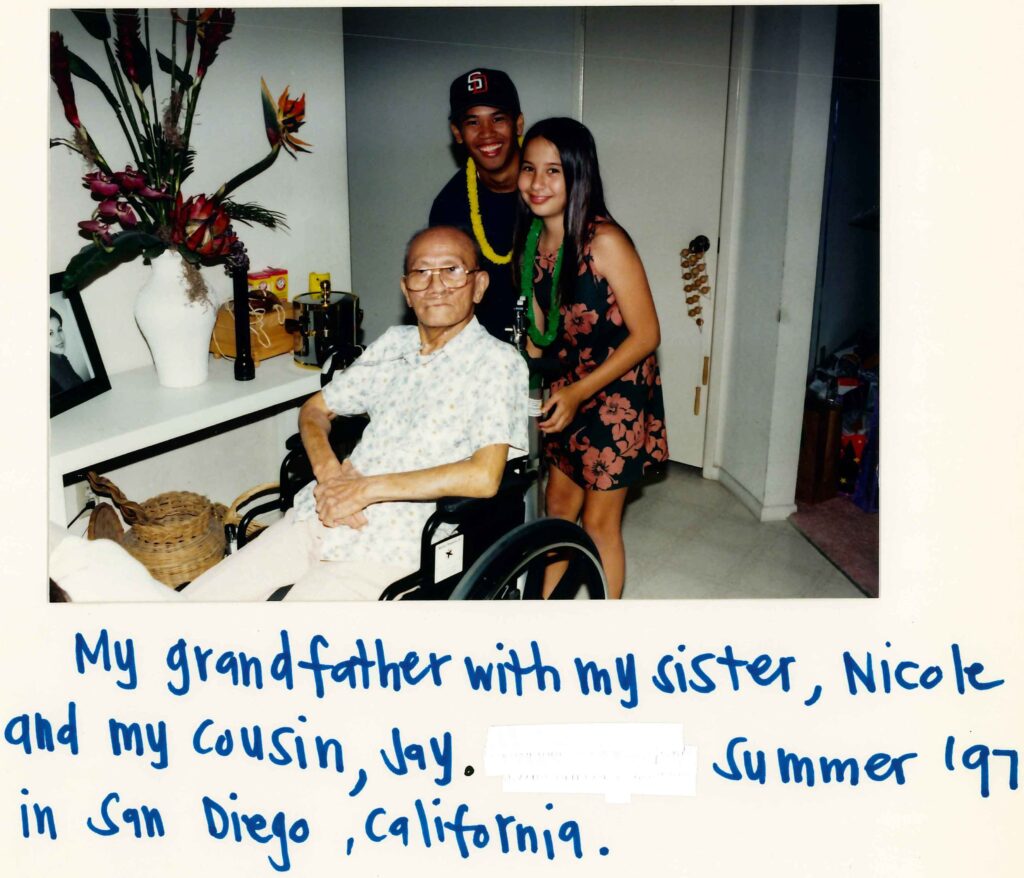
G06F, Cherlyn McQuilkin ‘99, Juanito Pakingan, Grandfather, 1914, Philippines
Juanito Pakingan is my grandfather on my mother’s side. He is now 83 years old, and he is currently living in San Diego, California, with my aunt and my grandmother, who is 82. He was happy to share his experience with me when I talked to him in November 1997. He hopes that my generation will learn about war, so that there will never be another one again.
World War II began on December 7, 1941, when Japan planned a sneak attack on Pearl Harbor. The Japanese government did not announce this in advance to the U.S., which was very upset. During the war, Japan and its allies, Germany and Italy, tried to defeat their enemies, which were the United States and Britain, including the Philippines.
At the time the Philippines was not independent, since the U.S. controlled our country. I was about 28 years old when the fighting started. I was one of the soldiers who were fighting against the Japanese for about three years. It was a scary experience. I always thought about my wife and family. I wasn’t sure that I would ever see them again. Every day I prayed for their safety. It was then when I realized how much my family meant to me.
This was a hard time for everyone. My wife, Luz Pakingan, was pregnant with our first child. One day some Japanese were chasing her with guns with sharp bayonets attached to each gun. My wife was so scared that she ran as fast as she could. She thought that she would be killed, but luckily a dog saved her life. The dog started barking at the soldiers, who were frightened and ran in the other direction. Sadly, though, my wife had a miscarriage, and we lost our first child, but that did not stop us from having children. About one year later, we had our first daughter.
There were many problems that we had to face. We had trouble finding food, because there wasn’t enough. One kind soldier gave my daughter a piece of sweet potato every time he passed by. Most of the time, there was only one dried fish that had to be shared among the family. Some families had many mouths to feed, so thousands died of starvation. There was a lot of destruction everywhere, and thousands of people were killed by Japanese bombs and gunfire. Dead bodies were scattered everywhere, especially at the Navy Yard in Cavite city.
On February 22, 1945, after fighting against the Japanese for about three years, I was part of a group which liberated over 2000 American soldiers from POW camps. I was honored to be one of the people who set soldiers free from those horrible, disgusting camps. During this same year, Japan announced its surrender on August 15. In July 1946, the Americans finally gave independence to our country. I was relieved to hear that the war was over. I hope that no one has to experience anything like this. War is wrong, and the younger generation should not repeat this silly mistake.