E08, Takako Kamei ‘94, Yoshiharu Kitamoto, Grandfather, 1911, China, Fukuoka
On November 29, 1992, I had the opportunity to interview my grandfather, who is 81 years old. He was born in the late Meiji era (1911, or Meiji 44-nen), and is one of the few who have lived through four eras: Meiji, Taishō, Shōwa, and Heisei. He was a direct participant in the Japan-China War and in World War II, which were among the biggest events in Japanese history. Although he is 81, he vividly remembered his experiences during the war, and he kindly agreed to share them with me. There was some repetition during his talk, but I was so absorbed that I did not mind hearing about some events again. This interview took place in his small, quiet room.
Takako (T): When were you asked to go to war?
Grandpa (G): It was on December 6, 1937 (Shōwa 12-nen). That day I received the letter called akagami or kaishū-reijo from the Imperial Army. It was such a thin piece of paper that I didn’t think it would contain such an important order from the military.
T: How did you feel?
G: I was frightened. I really thought that the letter had been sent to the wrong person. If not, it meant that Japan was already losing the war against China. I had had no training as a soldier, and if the Army was going to recruit a useless man like me, then Japan must be losing. I knew that some of my friends had already gotten this summons, but I never thought it would come to me. But if I refused, I would be sent to jail. So I had no choice but to just follow the orders. I was about to turn 27.
T: Where were you sent to first?
G: I was sent to Shanghai in China. From there I walked to Nanjing, which was the capital of China then. I don’t remember how long it took, but it seemed a very long way.
T: What was the battlefield like?
G: Well, even though I was a soldier, I didn’t actually fight on the battlefield. The orders that I got from the Army were to repair the telephone lines which had been disconnected by the Chinese. You see, they wanted to cut off our contact with other Japanese Army groups in different areas. Because of this job, we were called the Denshin-tai (Electro-communications Force).
T: Were you proud to fight for your country?
G: It wasn’t a matter of pride or fighting for one’s country. I had to follow orders. That was the only reason for me to fight.
T: Where were you when you heard about the atomic bombings of Hiroshima and Nagasaki?
G: In both cases, I was in Kurume, in Fukuoka prefecture, where I had been transferred. After the first bomb was dropped, my friend was sent to work in Hiroshima, and when he came back, he told me that all of the houses had fallen down, the tatami mats had blown away, and the city was a burned field. When I went there afterwards, I saw a staircase which was all burned black, except for one part when a person had probably been sitting.
T: How did you feel when you heard the announcement that Japan has lost the war?
G: Honestly, I wasn’t shocked by it. I knew the war was going to end soon, since most of the cities in Japan had been attacked and bombed by the enemy. I was also relieved that it was over. We were constantly afraid of the enemy attacks. One time, the American airplanes attacked the iron bridge near the Bridgestone tire factory where I worked. I was working in the factory that day and was told to hide under a five-story building. Then I heard a really loud noise outside which shook the building and broke the windows. After the enemy planes flew away, we all went outside and saw that the roof of the lecture hall was gone, and the iron bridge had disappeared. I think that half of Kurume city was burned down. When the fires started, the wind spread them in all directions, and we could not extinguish them. As a result, half of the city was gone.
T: What do you think about the war now?
G: I really think it was a foolish war. The leaders of the Japanese Army didn’t know anything about the strengths of the United States. They were too confident after occupying China. Also this war was decided by the Army leaders and had nothing to do with us ordinary citizens. But I had to forbear and wait patiently until peace came.
T: What did you feel about Americans?
G: When we were attacked in Kurume, we used to say that the next time the Americans come, we’ll attack them with bamboo spears. Of course, we all knew that we’d never do that, because it would be just like throwing your life away for nothing. But personally I did not hate Americans that much. After all, their attacks were the results that Japan got for participating in that stupid war. Who I hated most were the leaders of the Japanese Army who started the war. Because of their selfishness and greed to conquer more land, thousands of the people who had nothing to do with it were affected a great deal. During the war, the military told us that we were victorious in every battle, but we found out later that they had been lying to us all along. Even if they were beaten badly, they never used the word “retreat.” Instead they used the word tenshin, which means to change direction or proceed in the opposite way. This war was a foolish war. We lost too many precious lives. It should never happen again, ever.
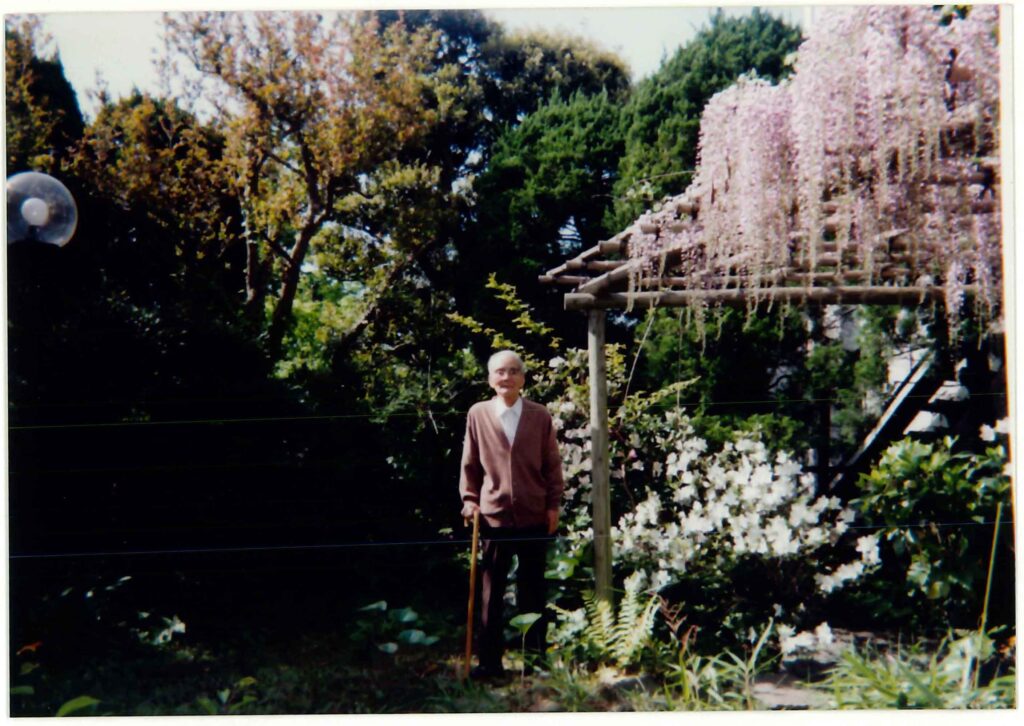
After the interview, I felt as though I had seen a different world. It was the first time that I had talked so seriously with my grandfather, and I was glad that I had the chance to hear about his personal experiences. He also looked happy, since not too many young people listen to elderly people these days. His descriptions were so different from what is written in textbooks. It was the real story. As he was talking, I could picture the scenes of the war. This was a very valuable interview, and I felt that this is a great way to learn history.